Breathing Exercises and Rhythmic Tapping: Tools to Manage Stress and Anxiety
Take control of your life with these simple yet effective stress management exercises.


We often take our mental health for granted. To manage stress at work and after a hard day is essential. Stress not only makes you burn out but also lowers your performance and makes you forget things.
But what if I tell you there is a simple way to manage stress and anxiety ? And no, it is not some lengthy meditation exercise or a complicated copying technique, but simply fidgeting your fingers and taking deep breaths.
It might sound cliché, but coming from personal experience, these things really can change your entire life. I have tried it and I recommend everyone to do it. So let’s get into the benefits of simple yet effective techniques.
Deep Breathing – Tool For Calming The Mind
Most people are well aware that three deep breaths and grounding techniques have been a go-to advice for calming anxiety. But it is not necessary to let things take control of you. Instead of getting burned out, control the problem from its roots.
Whenever you go through a difficult day or perform a strenuous task, then at the end, just close your eyes and take three deep breaths. Doing so will calm your nerves, refresh your mind, and make things appear clearer.
Taking some deep breaths throughout the day or after finishing a difficult task can soothe your brain.
But that is not all. Deep breathing has been scientifically known to reduce pain sensitivity by increasing the production of endorphins. Deep breathing techniques can also boost your immunity.
Performing breathing activities before sleep can even improve the quality of your rest. So, deep breathing is like your recharge mode.
Breathing Exercise Strategy
So what strategy should you adopt for breathing exercises? Deep breath throughout the day? Obviously not! But you can set out a time. Let me share my personal experience to help you figure out your routine.
I usually deep breathe three times a day: once when I try to relax, once after I finish a difficult task at work, and once before going to sleep. Combine this activity with some positive affirmations and see how everything changes for the better.
As a person who relates to the challenges of overthinking, there is no better relaxation technique for anxiety than deep breathing. It saved my life and now it can save yours.
Rhythmic Tapping-Relaxation Technique For Anxiety
Now this is something that you might not have heard before, and honestly speaking, there is not a ton of research on it. But personally, I have tried it and it is like a magical tool that works for managing anxiety and even to stop forgetting things.
Here is how the rhythmic tapping works: you use your fingers and tap on general points on your body, such as the head, side of the eye, under the chin, and arm.
Whenever you feel stressed or there is something you can’t let go of, you simply say a statement about how you feel, allow your brain to feel what it is feeling, and tap on specific points on your body while saying that you will figure everything out.
How To Improve Mental health With Rhythmic Tapping
So here’s how you put this technique in action to stop forgetting things. Let’s say you want to focus on a specific task, you can tap your fingers and say, that I need to focus on this task.
If you forget something and are trying to remember, then don’t stress your brain. Just lightly tap your fingers on the desk 3–4 times. Odds are that you’ll remember something.
You don’t have to tap randomly; you can also tap to the beat of your favorite song, a specific motto, or a persuasive tone.
Here is a table to guide you about rhythmic tapping, you can bookmark this article and use this table whenever you need:
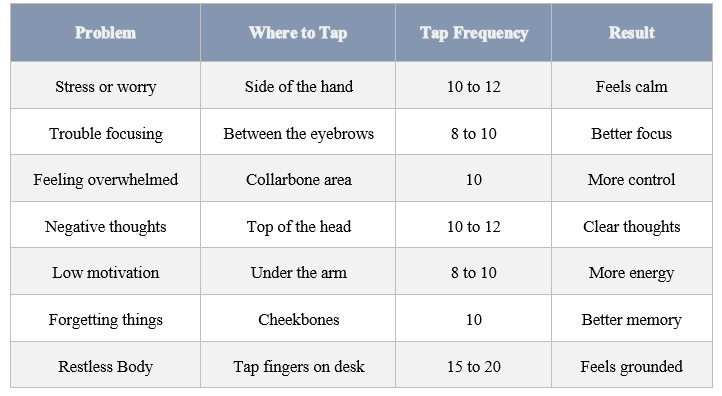
Rhythmic tapping can also come in handy when trying to be creative. By strategic tapping, mental blocks are removed, neurons are stimulated, and concentration becomes better, leading to a healthier and more active brain. So rhythmic tapping is not just an anxiety tool, but a life tool.
Now, here’s the real part: not every brain works the same way. What works for me might not click with you. So try a few rhythms, switch points, and figure out what settles your system best. You’re not just “fidgeting” you’re literally rewiring your stress and sharpening your focus.
Relaxation Technique Backed by Science
Rhythmic tapping has been termed as Emotional Freedom Technique ( EFT) in psychology.
According to research from Harvard Medical School and studies published in Frontiers in Psychology, this tapping sends a signal to the part of your brain, the amygdala, that you’re safe, and it lowers anxiety. The level of cortisol, a stress hormone, also goes down. After tapping, you’ll actually feel that stress is leaving your body.
A combined research published in the Journal of Nervous and Mental Disease explains how rhythmic tapping reduces anxiety and PTSD symptoms.
But that is not all. Rhythmic tapping is not just for managing anxiety; it can help you focus on a particular task and even remember forgotten things.
According to a study from the University of Oxford, incorporating small physical actions while memorizing can enhance recall. Your brain links the rhythm with the information. So next time you forget something, just simply tap your fingers.
3 Active Relaxation Techniques- My Personal Strategy
So now you know how to manage stress the easier way, it’s important to develop your own strategy to handle stress and anxiety. One thing that can even improve brain activity, along with deep breaths and EFT, is positive imagination.
Throughout the day, you can use deep breaths, positive affirmations, or pleasant imagery in your mind while tapping your fingers to calm your brain and stimulate neurons for better functioning.
This comes from someone who used to get stressed out, but now everything feels in control thanks to these effective relaxation techniques for anxiety.
The Real Question: Why is Mental Health Important
Mental health is often a taboo topic in many societies, but it is just as important as physical health; in fact, it may even be more essential.
When your mind works properly, you can handle tasks with confidence, feel happy, enjoy life, and spend quality time with loved ones. But if your mental health declines, it not only affects your quality of life but also impacts those around you.
Declining mental health can have drastic effects on your life, so it’s very important to learn mental health tips to soothe your brain.
Just like you wouldn’t skip meals and expect your body to perform, you can’t neglect your emotional wellbeing and expect your brain to stay sharp and your mood balanced. At the end of the day, always take care of your physical and emotional health.
Ready To Take Action ?
So, if you enjoyed this article and found the content helpful, let me know down below. Play your part in mental health awareness and share this article with your friends and family so they can also cope with their stress effectively.